Showing posts with label Pasig River. Show all posts

0

Ang Baha sa Manila, Ang Manila Bay, Ang Pasig River, at Ang "High Tide"

Posted on Wednesday, 14 August 2019


ANG BAHA SA MANILA, ANG MANILA BAY,  ANG PASIG RIVER,  AT “HIGH TIDE”
Ni Apolinario Villalobos

Ang baha sa Manila ay hindi dahil lang sa tuloy-tuloy na malakas na ulan nang kung ilang araw kundi dahil sa kawalan ng labasan ng tubig kung sumabay ang “high tide” o pagtaas ng tubig sa dagat kaya natatakpan  ang mga outlet o labasan ng tubig mula sa mga establisemento tulad ng hotel, restaurants, carinderias, at mga tirahan ng mga tao tulad ng mga bahay at  condominiums. Ang iba ay dumidiretso sa Manila Bay at ang iba ay lumalabas muna sa Pasig River.

Ang  tubig ng Pasig River ay sa Manila Bay dumadaloy o lumalabas. Maraming bayan ang dinadaan ng Pasig River na nakadugtong din sa Laguna de Bay at Marikina River kaya lahat ng mga bayan  na umaasa sa Pasig River bilang labasan ng tubig o outlet ay apektado din ng baha. Kapag high tide kaya tumataas ang tubig sa Manila Bay, hindi na nakakalabas dito ang tubig mula sa Pasig River, at kung sinabayan ng malakas na ulan, baha ang resulta.

Ang mga dating labasan ng tubig mula sa mga lumang bahay at business establishments sa Manila na sinimulang gawin noong panahon ng Kastila ay masyadong mababa kaya bumabalik sa mga ito ang tubig kapag hindi makalabas sa Pasig River kung high tide o tumaas ang tubig sa Manila Bay, KAHIT WALANG ULAN.

Hindi lang Manila ang apektado ng high tide na nagsasanhi ng baha kundi pati na rin ang Las Pinas, Paranaque at Cavite na ang ang hantungan ng dumadaloy mula sa drainage system nila ay  Manila Bay. Nang magkaroon ng reclamation project sa Manila Bay na tinayuan ng isang maunlad na distrito, nangyari ang pinangangambahan ng mga taga-Paranque  at ilang bahagi ng Las Pinas dahil “nasakal” ang dati ay maluwag na daluyan ng tubig mula sa mga ito patungo sa Manila Bay, kaya mabilis ang pagkaroon ng baha sa kanila kung tag-ulan.

Ang Marikina River ay nagdudugtong sa  Pasig River kaya kung bumalik ang tubig mula sa Manila tuwing high tide na sinabayan ng malakas na ulan, matinding baha din ang resulta.  Ang mga ilog na mula sa bulubunduking bahagi ng Rizal ay sa Marikina River din dumadaloy kaya nakakadagdag sila sa mabilis na pagtaas ng tubig na sanhi ng mabilis na pag-apaw.

HIGIT SA LAHAT, MAS MABABA ANG MANILA KAYSA WATER LEVEL NG DAGAT NA NOON PA LANG AY ALAM NA….AT DAHIL MAS MABABA KUNG IHAMBING SA IBA PANG MGA NAKAPALIGID NA BAYAN,  ITO ANG   PINAKALABASAN NG TUBIG MULA SA PASIG RIVER PAPUNTA SA MANILA BAY.

(The image of the Pasig River is from the Google archive.)


0

The Dismal Failure of the "Resettlement" Program for Informal Settlers in Manila

Posted on Saturday, 8 August 2015

The Dismal Failure of the “Resettlement” Program
for Informal Settlers in Manila
By Apolinario Villalobos

While the effort of the government to “save” Manila’s informal settlers from the danger of their abodes on the banks of esteros, underneath the bridge and unhealthy, as well as, filthy slums, is commendable, the sincerity is questionable. Where is sincerity in the promise about comfort in these resettlement areas that have no water facilities, lighted roads, public transportation, and electricity? To give a raw impression of these projects, footages of “comfortable” life in these areas are shown on TV, though it is purported that they consist just a very minimal percentage of completed units. The resettled families have no choice, but be resourceful to make the “shell” that the government call “house”, comfortable, rather than wait for the agency people to tell them that that at least, they need not worry about any demolition.

The resettled people worked in Manila business centers such as Divisoria, Sta. Cruz, Quiapo, Intramuros, Port Area, Malate, and Ermita, as well as airport terminals in Pasay City, and Makati. Some were paid the minimum wage. The rest were on daily contracted rates which were way below the minimum such as those working in stores and mall shops, in restaurants as waiters, cooks and waitresses. Some were junk collectors that rummage city dumps. Some were porters in piers and airport terminals, and still some were janitors, street sweepers, and part-time housekeepers. Their children went to schools which were walking distance away from their makeshift homes. Before the resettlement, the working members of the family already had barely enough daily fare, so that some walked to their job sites, making do with just biscuits for lunch. And then, they were forcefully resettled in the middle of school year, cutting short the studies of their children. Resettlement areas are in far off Bulacan, Cavite, Laguna and even Batangas. After the resettlement, most working members of the family quit their job for lack of daily fare to work.

Where is sanity in this supposedly “humane” program of the government? At times, even the rain could not stop the demolition of the makeshift homes, leaving the hapless families shivering, soaked to the bone, wet and hungry, crying their heart out while witnessing the tearing apart of their home that they painstakingly built out of salvaged tins and boards.

Cleared areas give way to malls and condos put up by foreign investors. Some are left as is – vacant, and just fenced in with barbed wire. The esteros or waterways that get cleared of shanties become clogged again by the waste from the upper portion of the Pasig river… floating on the stinking and murky water that flows out to Manila Bay, And the reason?... inconsistent cleaning and monitoring by authorities!  Yet, the government blames only the squatters for the perennial overflowing of these esteros! How about the factories and “legal” homes along the rivers which are also responsible for the waste and garbage that clog these waterways?

Meanwhile, the families in the pathetic resettlement areas try to survive on sweet potato leaves, kangkong, malunggay and wild indigenous vegetables, to go with their daily gruel of NFA rice. Some teen-aged daughters whose studies were cut short, try to help their family by trekking to nearby towns to work in market stalls and small eateries at Php100 a day. Mothers who used to gather vegetable trimmings in Divisoria to be sold on sidewalks or as part-time laundress near their former shanties in the city are left with nothing to do. Their husbands on the other hand cannot afford the more than three hundred pesos fare to their former jobs as porters at the port area and busy city wet markets.

As a last resort, desperate families sell the rights to their “home” and go back to where they came from to start another stage of survival. The government and the agency concerned seem blind to this vicious cycle as a result of their program that lack long-ranged planning. They thought that the solution to the urban squatting problem ends in the resettlement of the families. They forgot that the roof over the head is not just the basic need of man in order to survive. They forgot that such man has to work and earn in order to eat and do other endeavors to better his life, such as go to school.


What the government obviously wants are the numbers that they can print on reports about “rehabilitated” indigent Filipinos! Something for the world to see, that, indeed, poverty in the Philippines has been reduced!

0

A Philanthropist at Quinta Market of Quiapo...Baby "Bicol" Dionisio

Posted on Friday, 20 February 2015


A Philanthropist at Quinta Market of Quiapo
…Baby “Bicol” Dionisio
By Apolinario Villalobos

If I am around the Quiapo area and want to partake of my favorite eggplant torte, I would just go to my favorite carinderia (makeshift restaurant) at the Quinta market. The stall is beside the fish section. For more than nine years now, I did not know that the single mom, Baby “Bicol” Dionisio, who is tending the said eatery has been silently enduring trials that have befallen her, as under her care is a hydrocephalic granddaughter. Both sleep in the cramped area behind the counter, among their worldly possessions, and the worst time is during the flood season during which the overflowing murky water from the Pasig River which is a few meters away would flood the whole market for days, reaching up to her ankle, and during some seasons, up to her thigh. In addition to such nuisance is the several decades-old roof that drips rainwater.

I learned about her hydrocephalic granddaughter one morning when I dropped by for my favorite dish, before proceeding to the Hospicio de San Jose beside the Ayala Bridge, and which is just a few hundred meters away. During our animated conversation, she inadvertently mentioned about the child in her care. It came as a surprise. I did not know about her ward as every time I drop by, she was always cheerful. I did not know that in the crib is a handicapped child.

What touches me every time I drop by for my cheap breakfast is her very positive outlook despite her strangling financial needs for the health maintenance of the child. That morning, she told me that she has learned to leave her fate to the Lord, but added that she has never failed to exert much effort in earning for their daily survival by waking up as early as four in the morning to do her purchases and cooking, and since theirs is a public area, staying awake as late as ten in the evening. She also cheerfully mentioned that the child has learned to knock at her crib post to wake her up consistently every morning.

Baby’s daughter, the mother of the child, still has two children in her care and she is also doubling her effort to support them by doing odd jobs. She and her family live in a shanty by the Pasig River with her two other small children. Her husband drives a traysikad or pedaled tricycle. I was even more surprised when Baby pointed at an old man who was sleeping that morning on an old reclining chair in front of her stall. She said, the old man who is past his seventy years, and suffering from the dreaded Alzheimer’s disease is also under her care. As soon as she is free from attending to her customers, she checks the old man. She has no idea about her additional ward’s family. I had no courage to ask her how her caring for the old man started. I find it unethical. For me, what’s important is what is being done at the moment of need.

I did not mention to Baby about the Hospicio as I was not sure if the said institution could take care of semi-invalids such as her old ward. I am resolved, however, to at least try my best in helping her locate the family of the man for his own sake. Most often, victims of Alzheimer’s disease who could not find their way back home are painstakingly searched for by their families.

Baby’s friends in the market would sometimes extend their assistance, although, not regularly, to help lessen her financial burden. Despite her situation that could break the bearing of the weak in body and spirit, she would just smile while attending to her customers, with not a bit of complaint. Due to her very amiable personality, she exudes a warm aura that gives her face some kind of a radiance that veils her real age, making her look like fortyish despite her age of past sixty years. When I asked if it is okey to take her photo with her granddaughter beside the old man, she vehemently refused, but she did not hesitate to give me her real name. I only knew it after more than nine years, during which I would just call her “nene”. 

As always, people like “nene” or Baby keeps me going…


0

Intramuros: Magnificent Old Manila

Posted on Sunday, 31 August 2014


Intramuros: Magnificent Old Manila
By Apolinario Villalobos

For investors, especially, those who are the optimistic type who see gold even underneath a hill of debris, the remnants of Intramuros are an eyesore that should be leveled to give way to structures that could ensure a fat financial return, say, a commercial complex. The strategic position of this once Spanish glory, has made it more attractive to this kind of scheme.

On the other hand, those who value culture that is affected in a great extent by the past, see many reasons beyond the understanding of an ordinary person, why the partly ruined once walled city has to be reconstructed instead. This advocacy prevailed, so that a Presidential Decree was issued on April 10, 1979 for the creation of the Intramuros Administration which has been mandated for the restoration of the whole area. The first Chairperson of the said agency was no less than the former First Lady Imelda Marcos, and Jaime C. Laya as Action Officer. Management consultancy was extended by Esperanza Bunag Gatbonton.

The agency lost no time in reconstructing the Walled City, by building some new structures to house offices. As Intramuros has been habituated for so many years by informal settlers, clusters of makeshift homes had to be demolished.

Two guidelines were set for the rehabilitation program: reconstruction that necessitates the rebuilding of the Walled City, and the restoration of what could still be brought back to their original forms with the use of the same materials, a very delicate job requiring meticulous research and laboratory control of consistency.

Then, there’s the responsibility of assessing the e4xisting structures, their chances of withstanding atmospheric pollutants such as dust and carbon monoxide as well as natural calamities. The understandably difficult reinforcement of the standing structures with the use of available materials without altering their character and appearance is another thing to consider. Not to forget also is the problem posed by its modification in the form of electrification. There’s the question of where to install writings in a  very inconspicuous way.

Intramuros is a vast repository of invaluable heritage. Within its confines are the two centuries-old churches, the Manila Cathedral and San Agustin Church that contain images of saints, painting, sculptures, religious vestment, and ancestral homes that contain family heirlooms.

The Puerta de Isabel four-room museum contains family heirlooms such as intricately-carved hardwood chests, furniture, marble basin, images of saints, paintings, religious vestments, models of colonial houses, enlarged pictures of the early Intramuros and even cannons.

The Intramuros project has been schemed to be self-liquidating, so that hostels for students studying within the confine of the walls were built, as well as, economy class hotels for tourists, antique shops and restaurants.

The once walled city is trying to rise again. But what was it during its glory days?

The walls were intended to fortify the Spanish City of Manila which was developed from a tongue of land that extended out into the bay. This was what Matin de Goiti and Juan de Salcedo saw in 1570 upon their arrival from Panay. Guiding them past Mindoro and Balayan Bay was a trader, a Christia convert from Manila who also acted as their interpreter. The Spanish fleet consisting of a frigate, a junk and fifteen native boats sailed past Mindoro and Balayan Bay until they reached the busy port of a palisaded settlement.

Colonization was difficult but with the help of the Cross, the Spaniards were later settled. The settlement was followed by modification of Manila which affected even the natives’ way of life. Pallisades at the mouth of the river were enlarged. A defensive wall encircled the new settlement, improved by each succeeding governor-general.

The massive walls, built based on the Spaniards’ foresight was tested in the years to come, when the settlement was attacked by various forces. There was the notorious fleet of the Chinese pirate Limahong, the Dutch, rebels from the Chinese parian outside the walls, and the British. Each attack proved the formidability of some parts of the walls and vulnerability of some. It came to pass then, that the walls which were began by Legazpi himself in 1870, were improved by each succeeding governor-generals.

After so many years of improvement, the walls became a sophisticated fortress, surrounded with moats, ramparts, gates, bastions and lookout towers. Capping all these was the strict observance of curfew hours, as the gates were closed at eleven in the evening and opened only at dawn.

The sophistication of the walls was not limited to the surrounding structures. Even the buildings within were required to use non-combustible materials. Houses with thatched roofs went down. So that in no time at all, roofs of tiles, became the fashionable style as dictated by necessity. The Spaniards, likewise, used materials and methods familiar to them but with some changes adaptable to the tropics. Massive foundations of adobe gave strength to houses to withstand earthquakes. Convenient large windows made use of translucent capiz shells, and wooden parts were dovetailed to prevent splitting.

The Walled City was crammed with schools run by religious people of different orders, churches, dormitories and shops selling European items. It was an exclusive Spanish City, but there were times when a Chinese trader or two, or a native servant were allowed to reside within its confines.

Meanwhile, outside the Walled City, the parian, bustled with commerce dominated by the Chinese. Foreign merchants still came to sell their wares, some of which were patronized by Spaniards, themselves.

As time passed, however, the wall of exclusiveness was broken down, so that by the time the Americans came, the city had grown well beyond the thick structures. Gone was the sophistication. Development outside them was fast-paced and whatever left inside were the churches and schools, as well as, convents. The mestizos together with the friars were left to live with the somewhat deteriorating city.

Then, came the WWII in 1941 which flattened the Walled City, leaving only the sheels of what has been the glory of Spanish architecture. Some seventy-five percent of the walls withstood the bombings and a few of them, still stood intact, complete with lookout towers. The intricately beautiful gates of Fort Santiago and Sta. Lucia were rammed by American tanks during the liberation. Practically, the beautifully landscaped city was a mess when bombings ceased. It was sorry sight that greeted Manilans when they went out of their shelters.

For a long time, this particular section of a fast developing metropolis was neglected. Shanties mushroomed where mansions once stood. One-storey box-type buildings took the place of once elegant edifices. Big cargo vans and containers clogged its streets.

During its rehabilitation, the first to be touched was the Fort Santiago. Trees were planted to shade its lanes, a fountain was built and the cells were cleaned and converted into showcases of vintage cars. Canteens were also put up to serve promenaders and piped-in music system was installed. The fort was converted into a small park.

Other structures were reconstructed such as the Puerta de Isabel which now houses a museum and the offices of the Intramuros Administration. The San Agustin Church was restored to its once exquisite form, together with the Manila Cathedral. Other structures, even the privately-owned residences were rehabilitated in line with the plan to make the area as a veritable touristic nook within the city of Manila.

Today, Intramuros proudly stands, almost completely rehabilitated, except for some portions which are occupied by old houses. Overall, the once Walled City is now regaining its lost glory.
From Intramuros, one can have a leisurely walk to Fort Santiago, from which a jeepney can be taken for Luneta or Rizal Park.


0

Pasig River: Manila's Main Commercial Artery...long time ago

Posted on Sunday, 10 August 2014


Pasig River: Manila’s main commercial artery
… long time ago
By Apolinario Villalobos

“The Pasig, ah, the Pasig… the great old river”. The statement rings with deeply felt reverence, uttered by an old woman whose old age is made obvious by a pattern of wrinkles on her face. She now sells candles and bronze amulets just outside the Quiapo church. She’s from Taguig, but she could vividly recall days when she and her family would sail down the river on a dugout to Manila to sell vegetables and clay pots. According to her, on weekends, dugouts would compete with water lilies in clogging the river. While her father would curse at moving clusters of this hardy aquatic plant, they, the children would reach out to the brightly colored plumes. But now, those were just part of a once unharried life. The Pasig which has nurtured a city into becoming one that the world respects, is now gasping for breath.

The Pasig once began songs and poems, graced canvases and became an unseen participant in stage plays. Notable poets, like Jose Rizal, had always a special mention of the river to spice up a coterie of characters such as Ibarra, Maria Clara, and Doῆa Geronima, the “mutya” or queen of the river. In more ways than one, it has provided an exit for heroic characters in fiction stories just like Venice.

How it happen to be named after Pasig instead of Manila, is something the old folks could not remember. What they could recall is that, there was once a small delta, skimmed by what is now Ayala bridge which was believed to be the first site of Manila. It was called Isla de Convalescia, as it was here where a Spanish governor general would relax his nerves after a conflict with the clergy.

Records show that fleets of Chinese junks would cram the mouth of the river during the heyday of its glorious trading past, before the arrival of the Spaniards. On its banks, Chinese merchants would unload their wares that consisted of silk and brocade, jewelries, perfumes, wines, caged birds and exotic fruits. The Tagalogs (taga-ilog), the early Filipinos who settled along the river banks, also traded with merchants from Java, India, Sumatra and Siam (Thailand). It was for this reason that “alcaicerias” mushroomed near the riverbank to lodge these traders.

The river divides the city of Manila into northern and southern portions. Minor divisions are made by its tributaries and outflows, some of which are unfortunately filled today by unscrupulous urban developers to give way to commercial buildings, hence, their mysterious disappearance from the map. Linking then the divided city were eight bridges that span the river, with the four major ones, being the Del Pan (used to be the Puente de Espaῆa) that leads to the north harbor and northern of end of Divisoria, Jones that leads to the Chinatown and and the heart of Divisoria, MacArthur that leads to Sta. Cruz district with its famous Avenida, Quezon (formerly Puente Colgante) that leads to Quiapo district with its famous Quiapo Church and Islamic Center, and Ayala that leads to the University belt, Malacaῆan Palace and Sta. Mesa.

During the administration of Ferdinand Marcos, the river was regularly “patrolled” by River Aides to ensure the maintenance of its cleanliness. After Marcos, the project for its rehabilitation has been re-named every time a new President occupied Malacaῆan Palace, until lately, it died naturally. What remains today is the ferry service of the Metro Manila Development Authority (MMA) as its share in easing the traffic of Manila.

The river is calm most of the time, and whatever temperament it shows shortly after a heavy downpour soon disappears. During high tide, the current’s unimpeded flow pours out into Laguna de Bay through Jala-jala, the terminus in the river’s system, though, there are yet other towns and districts that benefit from the river’s flow.

Starting from Punta pier, there’s the Sta. Ana district, with its bridge called “Lambingan” (bridge of tryst). Going down south, the river flows by the once grand estate called Carmelence, where the moneyed of yesteryears once lived. Among the elegant residences, the most prominent is the Presidential Residence, seat of the national government, the Malacaῆan Palace. The residence was once a fenced Spanish home with a small zoo and aviary.

Right across the river to the left of the Palace is another landmark, the humble abode of Apolinario Mabini, also known in history as the sublime paralytic. Then there’s the old, Manila Boat Club which was founded in the nineteenth century.

Several hundred meters down is a cornucopia of abandoned industrial plants whose pipes used to constantly spew black and white smoke. Here, are warehouses whose stainless structures gleam under the glare of the sun.  A little further still, the main vein of the river branches into northern and southern flows. While the northern flow slices the old Sta. Mesa, the southern flow provides a natural boundary between Mandaluyong and Makati.

Passing Sta. Ana on the right, a thumb-like extension of land causes the river to slightly swerve. It is the Sta. Ana Archaeological site where artifacts that attest to the bank’s rich cultural past were unearthed. Cuddling a pocket of scalene area, just a few minutes from the archaeological site is Manila’s only race track.

On the left are more industrial warehouses, among which are squeezed residences which persisted on staying despite the polluted air. This row of industrial and residential structures continues even beyond the Guadalupe Bridge which serves as a link of Manila’s longest thoroughfare, the Epifanio de los Santos Avenue or EDSA that starts from Roxas Boulevard in Pasay City, and culminates at the Bonifacio Monument in Caloocan City.

A little further from Guadalupe is Pateros, once the seat of “balut” industry, but has lately gave way to the onslaught of housing developments that overran the once thriving duck pens along the river bank. “Balut” is the unhatched duck egg, treated with salt and slightly aged, then boiled. The unhatched chick is purported to be nutritious.

On the northeast, stretching towards the mountains is a delta on which peacefully settles Napindan, the last district along the Pasig River as it flows into Laguna de Bay. Napindan’s atmosphere is still rural, despite the presence of subdivisions. Marking Napindan is a lighthouse which from a distance could be mistaken for a mound. From its tower, one can view Talim Island, the biggest island in the lake.

The sloping mound of the grassy range points towards Jala-Jala, the town made famous by its fish corrals. From air, the offshore waters look like a huge green canvas painted with brown geometric figures. This area is devoted to milkfish farming.

On the northern bank of the river, from the Del Pan Bridge towards its mouth that opens towards Manila de Bay, can still be found the old buildings, once mute witnesses to the glorious Hispanic past of Manila. The area encompasses the districts of Quiapo, Sta. Cruz and Binondo where Escolta St, the once bustling commercial avenue of Manila is located. There is now, a proposal to rehabilitate Escolta, to make it a veritable touristic nook of the city, in addition to Intramuros and Luneta.

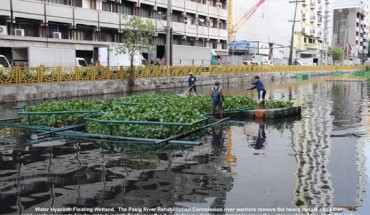
Not only Manilans, but the rest of Filipinos, are still hoping that something can be done for the rehabilitation of Pasig River despite the politics that beset both the local and national governments, if only, for the sake of its historic significance. As mentioned earlier, Pasig River has graced stanzas of poems and refrains of songs, aside from lines of stage actors in plays. No amount of pollution and thick clogs of water hyacinth and water lilies will eradicate the river from the face of Manila. For as long as the sea pushes its high tide through it towards Laguna de Bay, Pasig River shall persist to be Manila’s main artery.


0

Filipino Patriotism

Posted on Monday, 30 June 2014


Filipino Patriotism                                                    
By Apolinario Villalobos

Patriotism is nationalism – love of country. The extreme manifestation is fighting to death for the sake of one’s country. Filipinos are proud to use such adjective for themselves. Such show of patriotism was done first at the shores of Mactan Island in the province of Cebu where the Spanish Magellan was slain by Lapu-lapu, a local chieftain. The manifestation went on with the fight against Spain whose “conquest” of the country was made possible with the use of the cross. Later, the Filipinos showed this zeal against the Americans and Japanese.

Today, the patriotic fervor of the radical Filipinos consistently shows their disgust for the Americans whom they accuse of discreetly controlling the Philippine government. Unfortunately, this unrestrained outpouring of emotion results to vandalism. These are seen on defaced walls, bridges and fences spray-painted with communistic slogans, anti-American and anti-Filipino administration messages, not to mention the caricatures of hated local officials and whoever American president is sitting at the White House.

The radical groups keep on holding rallies at the US embassy and set aside the crucial issue against the intrusion by China of the West Philippine Sea. They do not hold rallies against the dumping of electronic waste in the country by other countries, the factories that dump waste into Pasig River and Manila Bay, the issue on Manila being developed by foreign drug lords as a distribution hub in Asia,  and the constantly rising tuition fees and prices of basic commodities, to name a few. These groups that carry red banners and streamers painted with hammer and sickle disrupt traffic on their way to Malacanan and US embassy…all because, they thought, they are patriotic, and to which I must honestly, though, partly conform.

For a change, why can’t these groups call the attention of local governments on the stinking public toilets and waterways clogged with garbage in their respective domains?…the beggars who literally convert sidewalks into makeshift homes and who should be given assistance by their respective social welfare offices?...the street urchins who are supposed to be rounded up and sheltered in juvenile homes?...the Badjaos who should be trained on livelihood endeavors rather than be tolerated begging in the streets?...and many more issues that could better occupy their time than harangue the Americans?

As a Filipino, I am also affected by the so-called “mismanagement” of our country resulting to the rampant corrupt practices, so deeply rooted that solutions seem to be no longer in sight. As an individual, though, I must admit that I am just an obscure voice in the wilderness of discontent. I want to be part of a movement for a patriotic advocacy, but how can I be encouraged to do it when all I see are groups that see violent acts as the only way of being heard? Never have I seen an attempt for restraint on their part. It seems that the more violent and provocative actions they have, the better for them to attract the attention of the media…hence, the better for their cause. 

Filipino patriotism should be tinged with values for which we are known. We are a non-violent and resilient race and our values should be manifested in all we do…including protest actions.